Infrastructure provision is falling through the cracks
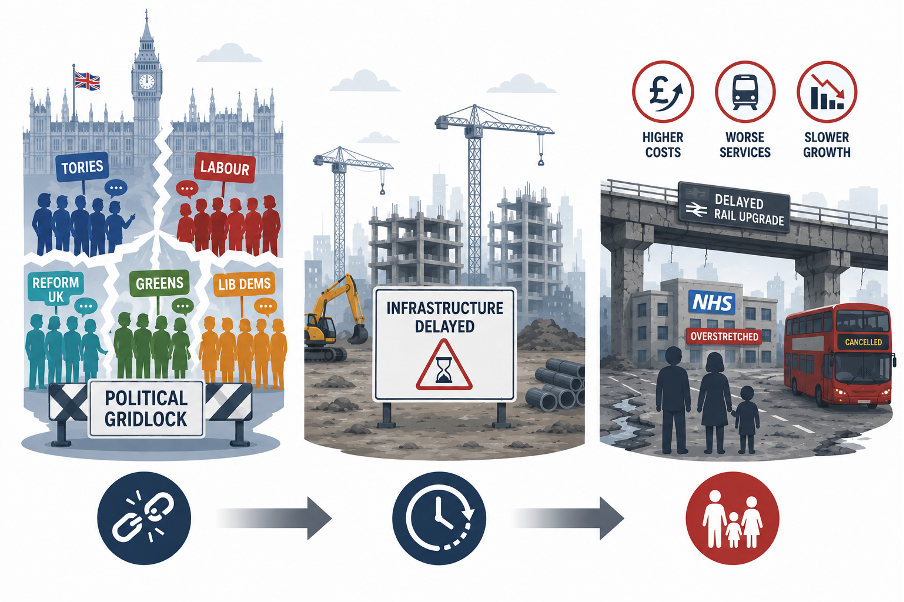
Last week’s elections created a new patchwork of political control of local authorities across the country, reflecting our emerging five-party system. London is particularly striking in its new patchwork comprising all of the five parties, and most noticeably the number of Labour-controlled councils reduced from 21 to 8.
While its all change for councils and their leadership, the challenges facing local authorities remain distinctly unchanged. And in the case of public infrastructure – requiring large, long-term spending commitments – the challenge has remained unmet and is now being painfully noticed. As a recent report on UK infrastructure investment observed, “ When infrastructure stops working, or doesn’t work as intended, we very quickly experience the impacts – and get angry about it … at best, failing or underperforming infrastructure causes inconvenience. At worst it costs lives.”
In addition to being long-term investments – which many councillors won’t see the benefit of – infrastructure projects, particularly in London, require strong coordination across boroughs. Bridges are the perfect example, and on this, London is failing. As the Independent reports this week, “London’s bridges are falling down and becoming a national embarrassment.”
This was by far the most frequently voiced concern heard while I door-knocked as a candidate in a target ward in Richmond-upon-Thames over the last few months for the recent local elections.
Residents almost to a person cited the challenges to their daily lives caused by the closure of Hammersmith Bridge to motorised traffic – even the many who weren’t motorists themselves - and expressed both anxiety and fatigue about its continued non-resolution, manifested in infighting between resident groups. Anxiety over Hammersmith Bridge has been exacerbated by the impending redevelopment of the Stag Brewery further upriver in Mortlake, which would only increase these challenges. This has less to do with the redevelopment itself, but the lack of a plan to mitigate the impacts of adding over one thousand new homes to an area bordered by a tidal river, a railway line and two level crossings.
“Traffic” was by far the word most frequently used when I asked voters about their concerns for the future of their local area. In fact, checking my notes, there were only a small minority that didn’t mention it – and as stated earlier, these were not all motorists. They were citing traffic as an essential element of their quality of life, and one for which they saw no resolution.
The local election delivered a singular victory to the LibDems in Richmond, who had already enjoyed a majority on the council, and now control all of 54 Councillor seats. With one-party rule it can move forward without opposition – but what will this mean for delivering the infrastructure that localities like Mortlake need?
Despite the lack of opposition, Richmond is fortunate – it has experienced councillors addressing these challenges. Across the country there are many newly elected councillors with little experience controlling local authorities facing big challenges. This morning I read about Havering - now under control of Reform - and its growing gap between demand for and provision of key service like GPs, dentists and schools due to big increases in housing development.
The borough is expected to deliver around 12,850 new homes over a ten-year period, equating to more than 1,200 homes/year and potentially tens of thousands of new residents moving into the area. But there is no plan to increase the healthcare infrastructure to service this growing population, and this delivery is extremely challenging given shifting NHS provision.
As veteran healthcare analyst Roy Lilley points out, NHS Integrated Care Boards which deliver neighbourhood services are designed around partnership, consensus and relationship management – and these they take years to build. If large parts of local government change political colour and personnel simultaneously, many of those informal networks disappear, and slows decision-making when it’s needed most. Will a Reform council in Havering be able to meet the health provision challenges to it residents, both new and old? We watch with interest.
And it’s this way across the country: in Sussex where “infrastructure planning is not fit for purpose”, according to recent reports, and both councils have changed control; in Preston where promised infrastructure has not been delivered to support new housing development and whose council has been plunged into no overall control in the recent local elections; in Kent where the local MP has intervened on housing targets due to limited water supply and whose council is now under a new Reform leadership.
Or indeed the 64 councils that ended up with no overall control at all --- how will they deliver the local infrastructure their residents and businesses need?
Not surprisingly, many in the built environment fear planning chaos in the wake of the local elections.
The traditional mechanism for funding local infrastructure has been Section 106 and CIL, traditionally the mechanism that unlocks funds from developers to mitigate the harms of development, usually through investment in local infrastructure and services. It’s been under the spotlight recently, and not in a good way.
Research from the Home Builders Federation estimates that local authorities in England and Wales are now sitting on over £9 billion of developer contributions, intended to fund essential local infrastructure such as schools, public transport and affordable housing. The money paid as part of planning agreements for new housing developments includes £6.6bn from Section 106 agreements and over £2.2bn raised through the Community Infrastructure Levy (CIL).
Of this £9 million of unspent funds, the HBF research shows that around £3 billion has been held for more than five years, despite many agreements requiring funds to be used within that timeframe, and that the average council holds £19 million in unspent Section 106 infrastructure contributions and £13.9 million in unspent CIL funds.
The government has responded to this with a revised policy called a Roadmap for Section 106 delivery in England”, aimed primarily at affordable housing. The Mayor of London has responded by offering developers time-limited relief from CIL. Neither of these initiatives will be successful unless there is clear oversight of how these monies are spent -- the challenge is not the absence of money, but the absence of systems designed to deploy it effectively.
As Matthew Syed recently suggested,
“It is perhaps worth remembering that this nation was once the undisputed world leader for empirical, long-term strategic judgment. We were among the first to build electricity infrastructure and turnpike roads; we pioneered railway construction and bridges and were the first to get coal out of the ground on a sufficient scale to ignite the Industrial Revolution -- but we have a political culture acting as a drag on all this creativity, drive and ambition, a system that has become detached both from the empirical world and the people it is supposed to serve.”
Let’s hope that the recent local elections are a wake-up call to address the danger of strategic infrastructure planning and investment falling through the cracks.
Clare Delmar
Listen to Locals
20 May 2026