Shifting to gentle density

In response to the housing crisis facing London and across the country, a growing number of voices are calling for an uptick in housing density.
A popular approach to this discourse is “gentle density”, a form of residential development which sits between high-rise, urban, apartment-style developments and low-rise, suburban housing.
Advocates include Create Streets, who argue that gentle density is the 'missing middle' of place-making—a network of beautiful streets, mansion blocks, and terraced homes anchored around a village green. “It is the Goldilocks of design: providing the personal space and green access people crave, while creating the vibrant, walkable neighbourhoods necessary for communities to flourish."
CBRE, the world's largest commercial real estate services and investment firm, advocates for gentle density as an approach to balance the risks and benefits of high-density living. “Gentle density is the term used to capture developments of three to seven storeys, essentially emulating the Georgian style mansion blocks of that era. This can increase the number of new homes whilst also maintaining a ‘human-scale’ character. It can also combat the loss of community that can sometimes come with tall tower blocks”, according to CBRE.
A recent article in City AM by Ike Ijeh of Policy Exchange argued that “to solve London’s housing crisis, don’t build tall, build beautiful”. Focusing on Maida Vale – which happens to be the most densely populated square kilometre in the country – he cites mansion blocks as“excellent density deliverers, effectively forming horizontal skyscrapers that pack thousands of residents into waves of linear blocks in concentrated neighbourhoods” and compares this to developments such as Nine Elms which has a gross density of approximately 88 dwellings per hectare while there are streets in Victoria and Kensington with densities of up to 200 dwellings p/h and beyond.
“Had the new Nine Elms development been covered with mansion blocks rather than skyscrapers”, he argues, “not only could we have created a timeless new neighbourhood far more sympathetic to London’s traditional scale and character, but, in the midst of a housing crisis, we could have built thousands more homes too. And, because mid-rise is cheaper to build, more of them could also have been used for affordable or social housing.”
Ijeh is Head of Housing, Architecture & Urban Space at Policy Exchange, which published the report ‘Tall Buildings: A Policy Framework for Responsible High-Rise and Better Density’in 2024. It argued that the “unplanned proliferation” of tall buildings has not delivered the housing Britain needs. Calling for a more responsible approach to urban density, the report concludes that building more tall buildings is not the solution to the housing crisis it is commonly presented as."
So gentle density sounds great – what’s not to like?
Not much, as I’m finding out now that I’m living - albeit temporarily while my house is renovated - in a very gently dense development in Kew, SW London. But there are conditions that limit and even detract from its benefits.
Kew Riverside is a 26-acre residential development on the banks of the river Thames in the London Borough of Richmond. It houses around 2500 residents in just over 500 homes. Completed in the early 2000s, it consists of Arts & Craft-inspired apartment blocks and townhouses, laid out around walkable paths and a central village green. Buildings are designed to be visually appealing, using soft curves and varied heights to avoid a monolithic appearance.
It's the epitome of gentle density.
But is it a nice place to live?
I’ll start with the good things
· It’s beautiful
· It’s safe and secure
· It’s well maintained
· It’s walkable
· It has accessible green and blue spaces
· It’s multigenerational
· It has sports facilities
· It’s carless (on the surface)
· It’s walkable to public transport
· It is linked to a primary school and GP surgery
· Everyone’s nice
· It’s quiet
and now for the not so good
· Its permeability is restricted –movement in and out is only via designated exits and entrances. There are no shortcuts and often one is moving backward to travel forward
· It’s entirely residential – there are shops outside the perimeter at Kew retail park and Kew Village - shops, pubs, station etc - is a 10-15 minute walk away
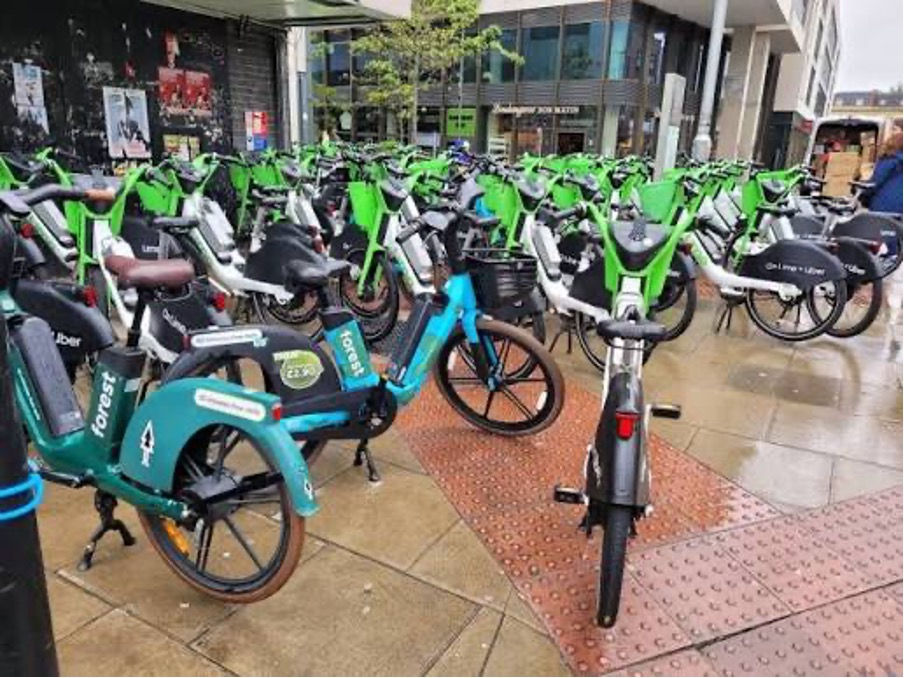
· Bike share is restricted – Limes cut out at gates
· It’s quiet – often too quiet
Kew Riverside is of course a gated community and not representative of typical urban living. It feels slightly contradictory to increase the density of an area without the amenities one associates with higher density – urban – living. In contrast to riverside developments further downriver (eg Wandsworth, Battersea) and across the river (eg Brentford) Kew Riverside is distinctly suburban.
And because it’s “gated”, the majority of residents’ engagement with local governance is with the development management itself, and not the Local Authority -- day-to-day maintenance, parking, security is undertaken by the former. It’s very transactional, and the service charge underpins pride of place.
But overall it works really well, and demonstrates how gentle density can significantly boost the quantity of housing on suburban sites without compromising the quality of life of residents old and new. If anything the development is a net contribution to the area having opened up a former brownfield site - and new population of residents - to the river Thames and points beyond.
A particularly attractive feature is the community’s blended generations – lots of families and young children and older retired residents living together. An adjacent site – a former treatment plant along the river – is currently being developed for retirement living.
Expect to see more gentle density downriver in the regeneration of the Stag Brewery in Mortlake, , which was granted planning consent in October after ten years of design and consultation.
Clare Delmar
Listen to Locals
27 February 2026