Ebike wars: can Lime lead the way in restoring harmony?
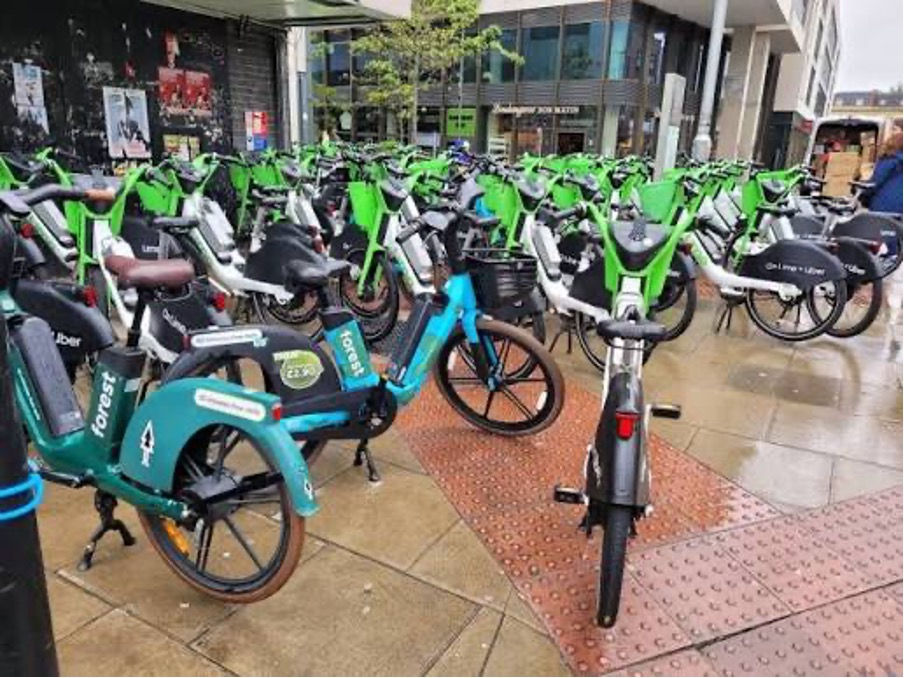
When the London Borough of Richmond-upon-Thames announced its intention to remove Lime from its ebike provision in March, residents raised a petition in disapproval which LBRuT called out as a response to “corporate bullying”.
This did not go down well. As I expressed in a letter to the Times, the petition was very much resident-led from those in the north of the borough, who are disproportionately impacted as they regularly transit across boroughs, facing what comic Dara O Briain described earlier this year as “Checkpoint Charlie” on London’s bridges.
Each of London’s 32 boroughs has its own rules on shared ebikes, causing stacks of one operator’s bikes at their imposed boundaries. It’s a ridiculous sight – but an increasingly familiar one – and many councils are calling on TfL to regulate the use of ebikes across London. The good news is that the English Devolution and Community Empowerment Act, passed earlier this year, gives licensing powers to TfL to create a single city-wide regulatory framework for dockless e-bike operators. TfL has welcomed the legislation and are working "to develop proposals for a London-wide licencing scheme". They have yet to publish a timetable for this.
In the meantime we must navigate this hodgepodge of provision, and endure (or ignore) the tensions it generates across boroughs and amongst residents.
Lime, throughout this buildup of noise, has remained noticeably quiet. One of the reasons for this is its recent IPO, which happened on July 1st. With Uber as an anchor investor, Lime raised just under £125m. So it can now pursue expansion and an agenda.
I’ve been curious about Lime’s role in the London ebike wars, because it is the largest and most widely used ebike provider in London – and now the most capitalised too. Of all the providers, Lime can take a strong leadership position on good practice and play a leading role in resolving some of the tensions around ebikes that have developed across London. So I went and asked Alice Pleasant, head of Public Affairs at Lime, about how she sees her company’s impact on London and what its vision is going forward.
Here is my interview:
What are the key measures of Lime's growth in London?
The clearest one for me is the TfL data - 1.5 million cycling trips happen across London every day now, which is up 43% since 2019, and around one in ten of those is on a dockless e-bike. So that's a big shift in five or six years.
But we don't just look at the top-line number. We're also trying to work out who's actually cycling and who isn't yet, and what's stopping them. That's part of why we launched LimePrime, to make the cost more predictable.
We've also introduced a new e-bike model - the LimeBike. We spoke with people generally underrepresented in the cycling community, like women and older people, to find out how we could make our bikes more accessible. The LimeBike has smaller wheels for improved stability and a lower step-through frame to make it easier to get on and off. We’ve also designed a more accessible phone holder and seat adjuster.
What do you see as your greatest challenges in sustaining and growing impact across London?
Demand for cycling has outpaced the infrastructure that's needed to support it, and parking is the most obvious symptom of that. We know we need to keep pavements clear, and we know the service needs to work for people who don't even use it, not just our riders. Through our London Action Plan, we've funded over 1,100 new parking bays since the start of last year, with more in the pipeline.
The other big challenge is that different boroughs have different operators and different rules, and that patchwork can make cycling across London harder than it should be. You feel this when you try to ride from central London into somewhere like Richmond, where the scheme, rules and availability suddenly change at the borough boundary.
Earlier this year Richmond Council decided to end its contract with Lime and offer a single-operator franchise to Forest. What is your reaction to this?
We're really sorry our service is no longer available in Richmond. Riders can still ride through Richmond, but they can't park or pick up a bike there anymore, so people who used the service regularly have lost something.
We had five good years there and we're proud that in 2025 alone we did over 1.5 million trips in Richmond, up 50% on the previous year. What concerns me more broadly is what a single-operator model means once you zoom out. Most people aren't cycling within one borough, they're travelling between multiple, often without even realising it. By creating a hard stop at a borough boundary, you can create friction, and this might stop people choosing to cycle.
Why doesn't London have a common bike sharing programme across boroughs? Is this something you're trying to achieve?
Because each borough runs its own procurement process, so you get one operator in one place, multiple in another, sometimes none. Residents end up dealing with different apps and different rules just moving across the city. In the longer term, we'd support a proper London-wide framework. The English Devolution and Community Empowerment Act is expected to bring bike scheme regulation up to a London-wide level, which we're supportive of.
How do you seek to win hearts and minds amongst your detractors, who often complain about pavement clutter and safety?
We know that there is still more we can do, and we’re constantly working to improve our service for both those who ride Lime and those who don’t. We know the best way we can win people over is by showing change on the ground. Our London Action Plan has helped create 3,500+ dedicated bays in total over the past few years, and we've grown our on-street team by 60% to 400+. We also added AI end-of-trip photo reviews to catch obstructive parking, and campaigns like Promise Codes to encourage safer riding. Building trust comes from consistent, visible change on the ground, so that's where we're focusing on delivering.
Do you focus on winning loyalty in a multi-provider city? Is this through reliability, accessibility and user experience, or pricing?
I don't think you can really separate those three out, reliability, accessibility and pricing all feed into each other. If a bike isn't reliably there and working, price doesn't matter much.
But on pricing, we have Lime Access, offering discounted rides to anyone with an eligible pass, such as a Blue Light Card, student card, Freedom Pass or other qualifying travel card.
Then we also have LimePrime, which is available to everyone and brings the cost down to roughly a bus fare, £1.70 for 20 minutes or £6.99 a month. These all work together to drive loyalty.
Do you currently seek input from local community groups on improving the Lime experience in local areas? Are there plans to increase this?
Yes, we do this quite a lot actually. We work with community groups like Cycle Sisters to make sure we know what’s happening in communities, we've done accessibility walks with the London Sight Loss Council, and we've got a Disability Advisory Board we chair. On top of that, we have monthly in-app rider surveys and QR-code feedback on our bikes.
Do you support local charities or community initiatives?
Through Lime Hero, riders can round up their fare and the difference goes to local causes — in London that's mostly gone to the Felix Project, and in one recent quarter that generated enough to provide over 34,000 meals. We also run a fund called Share The Joy with the London Cycling Campaign, which to date has given more than £280,000 to grassroots groups across the capital.
Do you look at how Lime has impacted health and wellbeing amongst its users? If so, what have you found?
We do look into this, yes. Most recently, our London “Gen C” research found that among 18–34-year-olds, 67% said cycling makes London more liveable and 75% said cycling is now part of London’s identity, not just a way of getting around.
More broadly, that suggests Lime’s impact goes beyond transport alone. People appear to feel more connected to the city through cycling, with shared bikes helping shape how they experience London day to day
What is your vision for the future of bike sharing in London?
I’d like to live in a London where cycling feels open to everyone - easy, accessible and fun, as well as a practical way to get around. To get there, we need to keep working with TfL and boroughs on safer infrastructure, maintain a reliable service, and make the experience of cycling across London feel joined-up and seamless wherever you are in the city.
Thanks to Alice and her team at Lime for their time, support andf insights.
Clare Delmar
Listen to Locals
4 August 2026